• Skip to content
  • Skip to navigation
You are currently in the Global version of the Grant Thornton website. Would you like to visit our United States website?
Go to:
grantthornton.com
  • About us
    • Why Grant Thornton
    • Culture and experience
    • Global scale and capability
    • Leadership, governance and quality
    • Meet our International Business Centre Directors
    • Join our network
  • Global locations
    • Africa
    • Americas
    • Asia-Pacific
    • Europe
    • Middle East
  • Services
    • Advisory
      • Advisory
      • Business consulting services
      • Business process solutions
      • Business risk services
      • Cybersecurity
      • Forensic services
      • Mergers and acquisitions
      • Recovery and reorganisation
      • Transactional advisory services
      • Valuations
      • Sustainability advisory
    • Assurance
      • Assurance
      • IFRS
      • Audit quality monitoring
      • Global audit technology
      • Sustainability assurance
    • Tax
      • Tax
      • Corporate and business tax
      • Direct international tax
      • Global mobility services
      • Indirect international tax
      • Transfer pricing
      • Africa tax desk
      • Sustainability tax
  • Industries
    • Asset management
    • Automotive
    • Banking
    • Business services
    • Energy and natural resources
    • Healthcare
    • Insurance
    • Life sciences
    • Media
    • Not for profit
    • Private equity
    • Public sector
    • Real estate and construction
    • Retail
    • Technology
    • Telecommunications
    • Travel, tourism and leisure
  • Topics
    • Latest insights
      • Latest insights
      • Thriving through disruption
      • Scaling sustainability
      • CFO success: Inspiring change in female mid-market leadership
      • Trade in transition
      • Navigating tariffs
      • Women in Business 2025
    • Growing internationally
      • Growing internationally
      • Thriving through disruption
      • Trade in transition
      • Navigating tariffs
      • Top five constraints to international business in the mid-market
      • Brand and international marketing – breaking global barriers
      • The key to international business: Investing in people
      • Building resilience in international business
      • International business: Mid-market growth and expansion
    • Diversity, equity and inclusion
      • Diversity, equity and inclusion
      • CFO success: Inspiring change in female mid-market leadership
      • Women in Business 2025: Impacting the missed generation
      • Women in tech: A pathway to gender balance in top tech roles
      • Women in leadership: A pathway to better performance
      • Women in Business 2024: Pathways to parity
      • Women in Business 2023: The push for parity
    • Environmental, social and governance (ESG)
      • Environmental, social and governance (ESG)
      • Scaling sustainability
      • The journey to a sustainable future
      • Promoting ESG excellence through tax
      • Understanding the impact of environmental taxes
      • Engaging with incentives to drive your ESG goals
      • Transparency and tax governance in the ESG era
    • International Financial Reporting Standards (IFRS)
      • International Financial Reporting Standards (IFRS)
      • Example Financial Statements
      • IFRS 8
      • IFRS 16
      • IAS 36
      • IFRS 17
    • Tax
      • Tax
      • Pillar 2
      • Global expatriate tax guide
      • International indirect tax guide
      • Global transfer pricing guide
  1. Home
  2. Press releases
  3. 2015
  4. Women in business 2015 results

Women in Eastern Europe point the way to senior management

05 Mar 2015

Women in business 2015 results

Annual business diversity tracker finds stagnation

As International Women’s Day approaches, new research from Grant Thornton reveals that Eastern European countries dominate the international league table for senior female business leaders, including seven of the top ten, with Russia at number one. However the proportion of women reaching the top tier of the business world has shown little progress over the past decade, leading to renewed calls for quotas, one of 12 recommendations set out in the report released today - Women in business: the path to leadership.
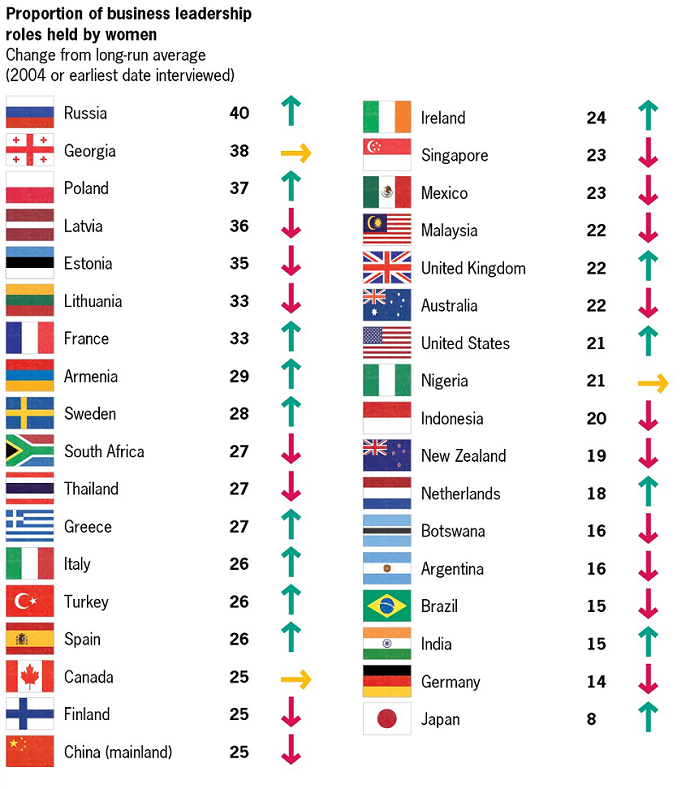
IBR Women in business 2015 league table

Grant Thornton’s research reveals that 40% of senior business roles in Russia are occupied by women, the highest in the world, and almost double the global average (22%). The next five countries on the list are all near neighbours: Georgia (38%), Poland (37%), Latvia (36%), Estonia (35%) and Lithuania (33%).

Francesca Lagerberg, global leader for tax services at Grant Thornton, said:
“The domination of Eastern European nations is explained by a complex blend of factors including history, culture and demographics. A thriving culture of female entrepreneurship is a legacy of the Communist ideal of equality of opportunity and this extends into the broad range of subjects women study in the region. Consequently we find women well represented in services industries too; and not just those traditionally with high numbers of women like healthcare and hospitality, but emerging industries such as financial services and technology.

“Simple demographics are undeniably at play too. Russia, for example, has 120 women for every 100 men.

“What can the rest of the world learn from Eastern Europe? Clearly there is no magic wand, but some of the recommendations we set out in our report - including changing societal norms around the role of women and eradicating gender bias - are directly drawn from what is working well in the region."

Globally, 22% of senior roles held by women is slightly up from 2004 (19%) but down from 24% last year, highlighting broad stagnation. Japan remains at the bottom of the list with just 8% of senior roles held by women, followed by Germany (14%) and India (15%). There have been pockets of improvement, however, with 26% of senior roles in the EU now occupied by women – an all-time high. This has been driven by France (33%), Sweden (28%) and Greece (27%). At the same time though the number in Latin America has fallen to 18% - an all-time low.

Francesca Lagerberg added:
“We’ve heard businesses talk the talk on gender equality for decades now, but still too few are walking the walk. Aside from the moral issue of ensuring equal opportunity for all, a more representative blend of women and men in senior roles just makes good business sense. If an economy is only using half its most talented people then it immediately cuts its growth potential.

“This presents real challenges not just for businesses but for governments, society and women too. Society must adjust to changes in the way we live and work; for example, the stigmatisation of men who choose to stay at home for family reasons must end. Governments can support this by facilitating shared parental leave but also building the infrastructure to allow women to thrive in the workforce. This could, for example, include mandating quotas for women on boards.”

Support for quotas on the rise
Grant Thornton’s research also reveals increasing support among business leaders for the introduction of quotas. Globally, almost half (47%) of both male and female senior managers now support quotas to get women on the boards of large listed companies, up from 37% in 2013.

Francesca Lagerberg said:
“Quotas are a fairly blunt instrument but it is not surprising that more people are seeing it as the best tool we have at this point in time, given the absence of progress on women in senior leadership. And rising support for their introduction suggests that businesses are looking for change from the top – even if this requires a push rather than a gentle nudge.

“Interestingly though, support for quotas in Eastern Europe stands well below the global average at just 30%. The region’s success in facilitating the career paths of women into senior leadership is a lesson for the rest of the world, and highlights the importance of culture change, which is arguably more important than compulsory measures.”

The full report, 'Women in business: the path to leadership', outlines 12 recommendations for society, government, business and women on how to facilitate female career paths.

– ends –

Share this page
  • Facebook
  • Twitter
  • LinkedIn
  • WhatsApp
  • Xing
  • Email

Related content

Women in business 2015 March 2015 Read more
A year of risk and reward February 2015 Read more
Women in business: classroom to boardroom March 2014 Read more

Connect Connect

  • Meet our people
  • Contact us
  • Global reach

About About

  • About us
  • Careers
  • Press
  • Modern slavery statement
  • GPPC

Legal Legal

  • Privacy policy
  • Disclaimer
  • Site map
  • Unauthorised trademark use
  • Transparency report 2024
  • Cookie Preferences

Services Services

  • Advisory
  • Assurance
  • Tax

Follow usFollow us

© 2025 Grant Thornton International Ltd (GTIL) - All rights reserved. "Grant Thornton” refers to the brand under which the Grant Thornton member firms provide assurance, tax and advisory services to their clients and/or refers to one or more member firms, as the context requires. GTIL and the member firms are not a worldwide partnership. GTIL and each member firm is a separate legal entity. Services are delivered by the member firms. GTIL does not provide services to clients. GTIL and its member firms are not agents of, and do not obligate, one another and are not liable for one another’s acts or omissions.