• Skip to content
  • Skip to navigation
You are currently in the Global version of the Grant Thornton website. Would you like to visit our United States website?
Go to:
grantthornton.com
  • About us
    • Why Grant Thornton
    • Culture and experience
    • Global scale and capability
    • Leadership, governance and quality
    • Meet our International Business Centre Directors
    • Join our network
  • Global locations
    • Africa
    • Americas
    • Asia-Pacific
    • Europe
    • Middle East
  • Services
    • Advisory
      • Advisory
      • Business consulting services
      • Business process solutions
      • Business risk services
      • Cybersecurity
      • Forensic services
      • Mergers and acquisitions
      • Recovery and reorganisation
      • Transactional advisory services
      • Valuations
      • Sustainability advisory
    • Assurance
      • Assurance
      • IFRS
      • Audit quality monitoring
      • Global audit technology
      • Sustainability assurance
    • Tax
      • Tax
      • Corporate and business tax
      • Direct international tax
      • Global mobility services
      • Indirect international tax
      • Transfer pricing
      • Africa tax desk
      • Sustainability tax
  • Industries
    • Asset management
    • Automotive
    • Banking
    • Business services
    • Energy and natural resources
    • Healthcare
    • Insurance
    • Life sciences
    • Media
    • Not for profit
    • Private equity
    • Public sector
    • Real estate and construction
    • Retail
    • Technology
    • Telecommunications
    • Travel, tourism and leisure
  • Topics
    • Latest insights
      • Latest insights
      • Thriving through disruption
      • Scaling sustainability
      • CFO success: Inspiring change in female mid-market leadership
      • Trade in transition
      • Navigating tariffs
      • Women in Business 2025
    • Growing internationally
      • Growing internationally
      • Thriving through disruption
      • Trade in transition
      • Navigating tariffs
      • Top five constraints to international business in the mid-market
      • Brand and international marketing – breaking global barriers
      • The key to international business: Investing in people
      • Building resilience in international business
      • International business: Mid-market growth and expansion
    • Diversity, equity and inclusion
      • Diversity, equity and inclusion
      • CFO success: Inspiring change in female mid-market leadership
      • Women in Business 2025: Impacting the missed generation
      • Women in tech: A pathway to gender balance in top tech roles
      • Women in leadership: A pathway to better performance
      • Women in Business 2024: Pathways to parity
      • Women in Business 2023: The push for parity
    • Environmental, social and governance (ESG)
      • Environmental, social and governance (ESG)
      • Scaling sustainability
      • The journey to a sustainable future
      • Promoting ESG excellence through tax
      • Understanding the impact of environmental taxes
      • Engaging with incentives to drive your ESG goals
      • Transparency and tax governance in the ESG era
    • International Financial Reporting Standards (IFRS)
      • International Financial Reporting Standards (IFRS)
      • Example Financial Statements
      • IFRS 8
      • IFRS 16
      • IAS 36
      • IFRS 17
    • Tax
      • Tax
      • Pillar 2
      • Global expatriate tax guide
      • International indirect tax guide
      • Global transfer pricing guide
  1. Home
  2. Press releases
  3. 2015
  4. Singapore, Israel, Australia top business growth environment index

Singapore, Israel, Australia top business growth environment index

16 Sep 2015

Singapore, Israel, Australia top business growth environment index

Singapore, Israel, Australia have beaten global competition to top the latest Grant Thornton Global Dynamism Index (GDI) which ranks the business growth environments of 60 leading economies.
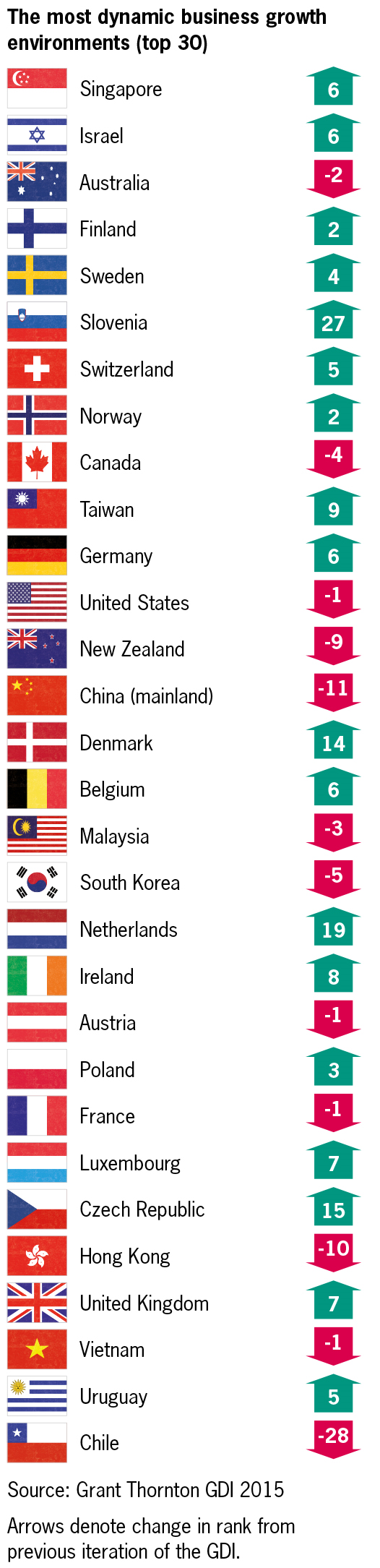
These countries offer dynamic businesses the right mix of regulatory stability, a strong labour market, technological infrastructure, growth opportunities and access to finance. However, comparing these results with the perceptions of business leaders about operating in different markets, suggests misconceptions could be stifling future international growth prospects.

Singapore (rank 1) leads the GDI 2015, rising six places from the previous iteration. It ranks top for financing environment and no lower than 25 (economics and growth) in any other growth area, highlighting the country’s robust, broad-based offer to dynamic businesses.

Israel (rank 2) has also risen six places this year. It comes top for technology due to strong research and development spending, and in the top 10 for financing environment. Australia (rank 3=) drops two places but still ranks in the top five for business operating environment and labour market. Finland (rank 3=) and Sweden (rank 5) have both risen slightly, due to their favourable business operating environments and an advanced technology infrastructure.

Paul Raleigh, global leader - growth and advisory services, said: “Market entry decisions are some of the toughest a business leader ever has to face. There are so many factors - both known and unknown - to consider. Uncertainty about what lies ahead can make it hard to make the case for action to colleagues and funding partners, and to manage risk effectively.

“The GDI can be used as a tool to help identify countries of interest by drawing on 22 indicators weighted according to the importance attached to them by real business leaders, adding that vital human perspective.”


Perception vs reality

However, further analysis of the results suggests business leaders may not be fully aware of the drivers and challenges of operating in different markets. Comparing the reality of the GDI with the
perceptions of business leaders from the Grant Thornton International Business Report (IBR) indicates some interesting knowledge gaps.

For example, Singapore, ranks top for the overall quality of its financial regulatory system in the GDI, but more than a quarter (28%) of business leaders questioned in the IBR perceive financial uncertainty or risk as a barrier to doing business there. The picture is similar for international investors in Germany where one in five cite financial risk as a barrier despite the country’s sound financial framework (rank 17=).

Paul Raleigh continued: “A lack of familiarity with a particular territory or region can skew perception and lead to unexpected challenges when expanding into a new market. For dynamic businesses, the trick is balancing instinct with reason, perception with reality.

“This study reveals how looking behind the headlines can uncover unexploited opportunities for dynamic businesses in new markets. The business world is always changing, with the realities on the ground often surprising business leaders who take a closer look. In order to maximise growth potential, business leaders need to refresh their perceptions of foreign markets in line with the market insights at their disposal.


Share this page
  • Facebook
  • Twitter
  • LinkedIn
  • WhatsApp
  • Xing
  • Email

Connect Connect

  • Meet our people
  • Contact us
  • Global reach

About About

  • About us
  • Careers
  • Press
  • Modern slavery statement
  • GPPC

Legal Legal

  • Privacy policy
  • Disclaimer
  • Site map
  • Unauthorised trademark use
  • Transparency report 2024
  • Cookie Preferences

Services Services

  • Advisory
  • Assurance
  • Tax

Follow usFollow us

© 2025 Grant Thornton International Ltd (GTIL) - All rights reserved. "Grant Thornton” refers to the brand under which the Grant Thornton member firms provide assurance, tax and advisory services to their clients and/or refers to one or more member firms, as the context requires. GTIL and the member firms are not a worldwide partnership. GTIL and each member firm is a separate legal entity. Services are delivered by the member firms. GTIL does not provide services to clients. GTIL and its member firms are not agents of, and do not obligate, one another and are not liable for one another’s acts or omissions.