• Skip to content
  • Skip to navigation
You are currently in the Global version of the Grant Thornton website. Would you like to visit our United States website?
Go to:
grantthornton.com
  • About us
    • Why Grant Thornton
    • Culture and experience
    • Global scale and capability
    • Leadership, governance and quality
    • Meet our International Business Centre Directors
    • Join our network
  • Global locations
    • Africa
    • Americas
    • Asia-Pacific
    • Europe
    • Middle East
  • Services
    • Advisory
      • Advisory
      • Business consulting services
      • Business process solutions
      • Business risk services
      • Cybersecurity
      • Forensic services
      • Mergers and acquisitions
      • Recovery and reorganisation
      • Transactional advisory services
      • Valuations
      • Sustainability advisory
    • Assurance
      • Assurance
      • IFRS
      • Audit quality monitoring
      • Global audit technology
      • Sustainability assurance
    • Tax
      • Tax
      • Corporate and business tax
      • Direct international tax
      • Global mobility services
      • Indirect international tax
      • Transfer pricing
      • Africa tax desk
      • Sustainability tax
  • Industries
    • Asset management
    • Automotive
    • Banking
    • Business services
    • Energy and natural resources
    • Healthcare
    • Insurance
    • Life sciences
    • Media
    • Not for profit
    • Private equity
    • Public sector
    • Real estate and construction
    • Retail
    • Technology
    • Telecommunications
    • Travel, tourism and leisure
  • Topics
    • Latest insights
      • Latest insights
      • Thriving through disruption
      • Scaling sustainability
      • CFO success: Inspiring change in female mid-market leadership
      • Trade in transition
      • Navigating tariffs
      • Women in Business 2025
    • Growing internationally
      • Growing internationally
      • Thriving through disruption
      • Trade in transition
      • Navigating tariffs
      • Top five constraints to international business in the mid-market
      • Brand and international marketing – breaking global barriers
      • The key to international business: Investing in people
      • Building resilience in international business
      • International business: Mid-market growth and expansion
    • Diversity, equity and inclusion
      • Diversity, equity and inclusion
      • CFO success: Inspiring change in female mid-market leadership
      • Women in Business 2025: Impacting the missed generation
      • Women in tech: A pathway to gender balance in top tech roles
      • Women in leadership: A pathway to better performance
      • Women in Business 2024: Pathways to parity
      • Women in Business 2023: The push for parity
    • Environmental, social and governance (ESG)
      • Environmental, social and governance (ESG)
      • Scaling sustainability
      • The journey to a sustainable future
      • Promoting ESG excellence through tax
      • Understanding the impact of environmental taxes
      • Engaging with incentives to drive your ESG goals
      • Transparency and tax governance in the ESG era
    • International Financial Reporting Standards (IFRS)
      • International Financial Reporting Standards (IFRS)
      • Example Financial Statements
      • IFRS 8
      • IFRS 16
      • IAS 36
      • IFRS 17
    • Tax
      • Tax
      • Pillar 2
      • Global expatriate tax guide
      • International indirect tax guide
      • Global transfer pricing guide
  1. Home
  2. Press releases
  3. 2015
  4. Russia offers good technology and an improving financing

Russia offers good technology and an improving financing

16 Sep 2015

Russia offers good technology and an improving financing

New research reveals an improved financing environment alongside strong science and technology infrastructure can still help to attract dynamic businesses to Russia despite a low ranking in the Grant Thornton Global Dynamism Index (GDI)
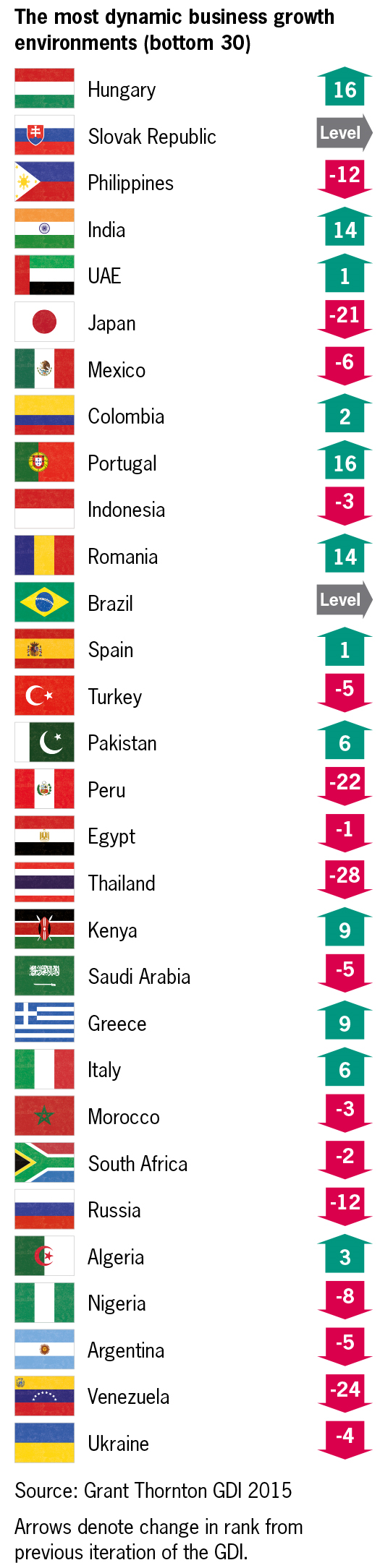
The most dynamic business growth environmentWhen assessing a range of business dynamism factors in Grant Thornton’s Global Dynamism Index (GDI), Russia ranks 55 out of 60 markets. However, this does not seem to have shaken the confidence of businesses expanding into the country who are keen to highlight the positives, such as access to a key market and key clients while downplaying the difficulties.

The GDI shows that Russia ranks highest in the area of technology, due to strong growth in broadband subscriber numbers and consistent research and development spending. The financing environment has also improved over the past two years, with the country rising 11 places in the GDI according to this measure. Among the areas where Russia struggles are business operating environment (52 out of 60) and economics and growth (49 out of 60).

Globally, Singapore offers the best business growth environment for dynamic businesses according to the GDI as a result of a strong financing and regulatory environment. Israel (rank 2) has also risen six places this year. Australia (rank 3=) drops two places but still ranks in the top five for business operating environment and labour market. Finland (rank 3=) and Sweden (rank 5) have both risen slightly, due to favourable business operating environments and an advanced technology infrastructure.

Perception vs reality

However, further analysis suggests business leaders may not be fully aware of the drivers and challenges of operating in Russia. According to Grant Thornton’s International Business Report (IBR), business leaders who either operate in Russia, or plan to over the next 12 months, perceive the country to be a better place to do business than many other major economies. Only 12% of business leaders cite currency fluctuations as a barrier for expansion into the country and less than a quarter (24%) say cash extraction is a factor that puts them off expanding into the country.

Market growth potential is another area where Russia punches above its weight in foreign business leaders’ perceptions. Nearly two-thirds (64%) of business leaders cite access to a key market as a major driver for expansion into Russia. Meanwhile, 58% believe that the country offers them proximity to key clients and around a third (32%) say the geographical closeness to supply chains is an appeal.

Local market spokesperson, said: “In a globalised world, businesses looking for opportunities in dynamic markets must consider a range of economic, social and political factors when making decisions. They must balance instinct with reason, perception with reality.

“At the moment, Russia is benefiting from this perception bias. Businesses clearly feel that there are numerous advantages to doing business in the country that might not be captured in official data. However, as advisors to businesses, it’s our job to make sure firms have the full facts at their disposal when making key decisions.

“The business world is always changing, with the realities on the ground often surprising business leaders who take a closer look. In order to maximise growth potential, business leaders need to refresh their perceptions of foreign markets in line with the market insights at their disposal. Once in tandem, better decisions can be made.”

Share this page
  • Facebook
  • Twitter
  • LinkedIn
  • WhatsApp
  • Xing
  • Email

Connect Connect

  • Meet our people
  • Contact us
  • Global reach

About About

  • About us
  • Careers
  • Press
  • Modern slavery statement
  • GPPC

Legal Legal

  • Privacy policy
  • Disclaimer
  • Site map
  • Unauthorised trademark use
  • Transparency report 2024
  • Cookie Preferences

Services Services

  • Advisory
  • Assurance
  • Tax

Follow usFollow us

© 2025 Grant Thornton International Ltd (GTIL) - All rights reserved. "Grant Thornton” refers to the brand under which the Grant Thornton member firms provide assurance, tax and advisory services to their clients and/or refers to one or more member firms, as the context requires. GTIL and the member firms are not a worldwide partnership. GTIL and each member firm is a separate legal entity. Services are delivered by the member firms. GTIL does not provide services to clients. GTIL and its member firms are not agents of, and do not obligate, one another and are not liable for one another’s acts or omissions.