• Skip to content
  • Skip to navigation
You are currently in the Global version of the Grant Thornton website. Would you like to visit our United States website?
Go to:
grantthornton.com
  • About us
    • Why Grant Thornton
    • Culture and experience
    • Global scale and capability
    • Leadership, governance and quality
    • Meet our International Business Centre Directors
    • Join our network
  • Global locations
    • Africa
    • Americas
    • Asia-Pacific
    • Europe
    • Middle East
  • Services
    • Advisory
      • Advisory
      • Business consulting services
      • Business process solutions
      • Business risk services
      • Cybersecurity
      • Forensic services
      • Mergers and acquisitions
      • Recovery and reorganisation
      • Transactional advisory services
      • Valuations
      • Sustainability advisory
    • Assurance
      • Assurance
      • IFRS
      • Audit quality monitoring
      • Global audit technology
      • Sustainability assurance
    • Tax
      • Tax
      • Corporate and business tax
      • Direct international tax
      • Global mobility services
      • Indirect international tax
      • Transfer pricing
      • Africa tax desk
      • Sustainability tax
  • Industries
    • Asset management
    • Automotive
    • Banking
    • Business services
    • Energy and natural resources
    • Healthcare
    • Insurance
    • Life sciences
    • Media
    • Not for profit
    • Private equity
    • Public sector
    • Real estate and construction
    • Retail
    • Technology
    • Telecommunications
    • Travel, tourism and leisure
  • Topics
    • Latest insights
      • Latest insights
      • Thriving through disruption
      • Scaling sustainability
      • CFO success: Inspiring change in female mid-market leadership
      • Trade in transition
      • Navigating tariffs
      • Women in Business 2025
    • Growing internationally
      • Growing internationally
      • Thriving through disruption
      • Trade in transition
      • Navigating tariffs
      • Top five constraints to international business in the mid-market
      • Brand and international marketing – breaking global barriers
      • The key to international business: Investing in people
      • Building resilience in international business
      • International business: Mid-market growth and expansion
    • Diversity, equity and inclusion
      • Diversity, equity and inclusion
      • CFO success: Inspiring change in female mid-market leadership
      • Women in Business 2025: Impacting the missed generation
      • Women in tech: A pathway to gender balance in top tech roles
      • Women in leadership: A pathway to better performance
      • Women in Business 2024: Pathways to parity
      • Women in Business 2023: The push for parity
    • Environmental, social and governance (ESG)
      • Environmental, social and governance (ESG)
      • Scaling sustainability
      • The journey to a sustainable future
      • Promoting ESG excellence through tax
      • Understanding the impact of environmental taxes
      • Engaging with incentives to drive your ESG goals
      • Transparency and tax governance in the ESG era
    • International Financial Reporting Standards (IFRS)
      • International Financial Reporting Standards (IFRS)
      • Example Financial Statements
      • IFRS 8
      • IFRS 16
      • IAS 36
      • IFRS 17
    • Tax
      • Tax
      • Pillar 2
      • Global expatriate tax guide
      • International indirect tax guide
      • Global transfer pricing guide
  1. Home
  2. Press releases
  3. 2014
  4. Reversal of fortune in superpower sentiment

Reversal of fortune in superpower sentiment

11 Jun 2013

2014

  • OECD BEPS project faces uphill battle
  • Global private equity report 2014/15
  • Mining M&A expected to double as market elements align
  • New Grant Thornton firm in Belize
  • Businesses in mature markets break investment inertia
  • Good CSR makes good business sense

US business confidence on the rise as China falls away

New research from Grant Thornton’s International Business Report (IBR), a quarterly global business survey of more than 3,200 businesses in 44 economies, reveals a dramatic reversal of fortunes for business leaders in the world’s two largest economies. While US businesses are feeling more confident about growth in their operations and the economy, optimism amongst peers in China has slumped to the lowest level recorded in IBR history.
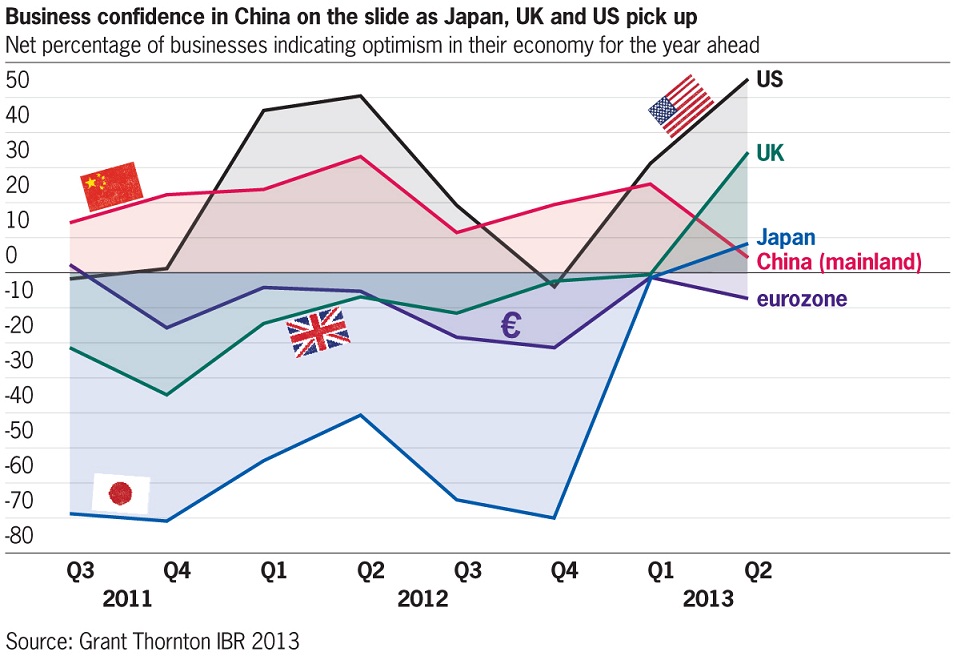
Net percentage of businesses indicating optimism in their economy for year 2015

The IBR reveals that US business optimism climbed to net 55% in Q2, up from 31% in Q1, and the highest level recorded since 2005. This improving sentiment flows through to US business growth expectations; net 59% expect to see revenues climb over the next 12 months, up from 46% in Q1, and 48% expect profits to grow, up from 42% three months previously.

By comparison, business optimism in China fell to just net 4% in Q2, down from 25% in Q1 and the lowest level since 2006 (when businesses were first interviewed in China for IBR). Chinese businesses are less confident about increasing revenues (down from net 72% in Q1 to 60% in Q2), exports (29% to 15%) and profitability (69% to 42%) over the next 12 months.

Ed Nusbaum, global CEO at Grant Thornton, commented: “The divergence in the data is relative in that China is coming off a big high and the US off a deep low. Ultimately global growth prospects would be best served by a strengthening of both markets but broader macroeconomic trends are feeding into business sentiment.

"In the US, the Federal Reserve recently suggested it could wind up its programme of quantitative easing by this time next year if the economy keeps improving. Meanwhile rising house prices, increased construction starts and continuing strong stock market performance are helping to boost both business and consumer confidence.

"By contrast, China's economy is slowing. Exports grew by just 1% in May due to weakness in key markets such as the EU. And the new leadership appear eager to rein in credit growth with fears that a housing bubble is building. The downside of course is that this reduces the spending power of businesses and consumers and the People’s Bank of China has since had to inject liquidity into its banking system last month to stave off a credit squeeze."

Global business optimism holds as Japan and UK rally

An improvement in G7 business confidence in Q2 balanced out a slide in that of the BRIC economies. In the UK, business optimism climbed from net -1% in Q1 to 34% in Q2, whilst sentiment in Japan turned positive for the first time in IBR history, rising to net 8% fuelled by the stimulus and reform measures of the new leadership, dubbed 'Abenomics'.

Eurozone business confidence remains fragile however, sliding to net -8% in Q2, down from -2% three months previously. Mirroring China, business sentiment dropped in the other three BRIC economies, meaning G7 business optimism (32%) climbed above the BRIC average (23%) in Q2 – another first in IBR history.

- ends - 

Share this page
  • Facebook
  • Twitter
  • LinkedIn
  • WhatsApp
  • Xing
  • Email

Connect Connect

  • Meet our people
  • Contact us
  • Global reach

About About

  • About us
  • Careers
  • Press
  • Modern slavery statement
  • GPPC

Legal Legal

  • Privacy policy
  • Disclaimer
  • Site map
  • Unauthorised trademark use
  • Transparency report 2024
  • Cookie Preferences

Services Services

  • Advisory
  • Assurance
  • Tax

Follow usFollow us

© 2025 Grant Thornton International Ltd (GTIL) - All rights reserved. "Grant Thornton” refers to the brand under which the Grant Thornton member firms provide assurance, tax and advisory services to their clients and/or refers to one or more member firms, as the context requires. GTIL and the member firms are not a worldwide partnership. GTIL and each member firm is a separate legal entity. Services are delivered by the member firms. GTIL does not provide services to clients. GTIL and its member firms are not agents of, and do not obligate, one another and are not liable for one another’s acts or omissions.