• Skip to content
  • Skip to navigation
You are currently in the Global version of the Grant Thornton website. Would you like to visit our United States website?
Go to:
grantthornton.com
  • About us
    • Why Grant Thornton
    • Culture and experience
    • Global scale and capability
    • Leadership, governance and quality
    • Meet our International Business Centre Directors
    • Join our network
  • Global locations
    • Africa
    • Americas
    • Asia-Pacific
    • Europe
    • Middle East
  • Services
    • Advisory
      • Advisory
      • Business consulting services
      • Business process solutions
      • Business risk services
      • Cybersecurity
      • Forensic services
      • Mergers and acquisitions
      • Recovery and reorganisation
      • Transactional advisory services
      • Valuations
      • Sustainability advisory
    • Assurance
      • Assurance
      • IFRS
      • Audit quality monitoring
      • Global audit technology
      • Sustainability assurance
    • Tax
      • Tax
      • Corporate and business tax
      • Direct international tax
      • Global mobility services
      • Indirect international tax
      • Transfer pricing
      • Africa tax desk
      • Sustainability tax
  • Industries
    • Asset management
    • Automotive
    • Banking
    • Business services
    • Energy and natural resources
    • Healthcare
    • Insurance
    • Life sciences
    • Media
    • Not for profit
    • Private equity
    • Public sector
    • Real estate and construction
    • Retail
    • Technology
    • Telecommunications
    • Travel, tourism and leisure
  • Topics
    • Latest insights
      • Latest insights
      • Thriving through disruption
      • Scaling sustainability
      • CFO success: Inspiring change in female mid-market leadership
      • Trade in transition
      • Navigating tariffs
      • Women in Business 2025
    • Growing internationally
      • Growing internationally
      • Thriving through disruption
      • Trade in transition
      • Navigating tariffs
      • Top five constraints to international business in the mid-market
      • Brand and international marketing – breaking global barriers
      • The key to international business: Investing in people
      • Building resilience in international business
      • International business: Mid-market growth and expansion
    • Diversity, equity and inclusion
      • Diversity, equity and inclusion
      • CFO success: Inspiring change in female mid-market leadership
      • Women in Business 2025: Impacting the missed generation
      • Women in tech: A pathway to gender balance in top tech roles
      • Women in leadership: A pathway to better performance
      • Women in Business 2024: Pathways to parity
      • Women in Business 2023: The push for parity
    • Environmental, social and governance (ESG)
      • Environmental, social and governance (ESG)
      • Scaling sustainability
      • The journey to a sustainable future
      • Promoting ESG excellence through tax
      • Understanding the impact of environmental taxes
      • Engaging with incentives to drive your ESG goals
      • Transparency and tax governance in the ESG era
    • International Financial Reporting Standards (IFRS)
      • International Financial Reporting Standards (IFRS)
      • Example Financial Statements
      • IFRS 8
      • IFRS 16
      • IAS 36
      • IFRS 17
    • Tax
      • Tax
      • Pillar 2
      • Global expatriate tax guide
      • International indirect tax guide
      • Global transfer pricing guide
  1. Home
  2. Press releases
  3. 2014
  4. Renewed hiring failing to boost salaries

Renewed hiring failing to boost salaries

24 Jan 2014

2014

  • OECD BEPS project faces uphill battle
  • Global private equity report 2014/15
  • Mining M&A expected to double as market elements align
  • New Grant Thornton firm in Belize
  • Businesses in mature markets break investment inertia
  • Good CSR makes good business sense

New figures from Grant Thornton’s International Business Report (IBR)

 New figures from Grant Thornton’s International Business Report (IBR) reveal that companies globally are expecting to take on more workers compared with this time last year. However, the data also shows that with significant slack in many labour markets, this increased hiring is unlikely to lead to significant salary increases across the next 12 months.
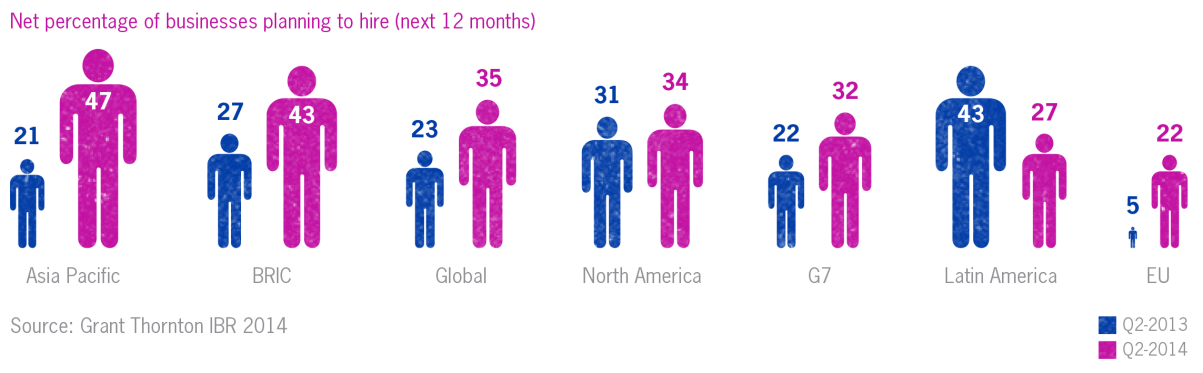
net percentage of businesses planning to hire in 2014

Globally, the proportion of businesses expecting to expand their workforce over the next 12 months has risen to 35%, up from 22% this time last year, and the highest since 2007. Strong hiring plans are evident across the world: 43% of BRIC businesses plan to take on new people, up from 22% in Q2-2013; in the G7 the figure is up from 22% to 32% over the same period. Net 22% of businesses in Europe expect to hire more people, up from just 5% 12 months ago; in North America the figure has risen three percentage points to 34%; and in Asia Pacific, almost half of businesses are planning to hire (47%), up from a fifth this time last year (21%). Only in Latin America have employment prospects worsened over the past 12 months. 

However the impact of this extra hiring is unlikely to result in large salary increases, at least in the short-term, according to the IBR. Across the G7, just 64% of businesses plan to offer their people pay rises over the next 12 months, down from 68% this time last year, while just 10% are planning inflation-busting rises. In Europe, workers in 68% of businesses can expect to see their salaries rise, up from 55% this time last year, although this falls to just 17% who plan to offer above inflation salary rises.

Francesca Lagerberg added:

“There is still significant slack in advanced economy labour markets. Unemployment has fallen fairly rapidly in the UK and US, while Germany's employment rate remains remarkably high, but more than 10% of working age people are looking for work in Europe, rising to around one in four in southern Europe. Businesses in Europe do seem to be slowly raising salaries but with deflation now the major concern across the eurozone, the data suggest people should not be expecting large increases.

"With supply outstripping demand, businesses can afford wait for sustainable sales growth before they start investing in new workers and paying higher salaries to maintain their existing talent.  The judgement of business owners and managers will be key to ensuring that productivity and profits don’t suffer as a result of gearing up too early." 


Notes to editors

The Grant Thornton International Business Report (IBR) provides insight into the views and expectations of more than 10,000 businesses per year across more than 30 economies. This unique survey draws upon 22 years of trend data for most European participants and 11 years for many non-European economies. For more information, please visit: www.internationalbusinessreport.com 

Data collection

Data collection is managed by Grant Thornton's core research partner – Experian. Questionnaires are translated into local languages with each participating country having the option to ask a small number of country specific questions in addition to the core questionnaire. Fieldwork is undertaken on a quarterly basis. The research is carried out primarily by telephone.

Share this page
  • Facebook
  • Twitter
  • LinkedIn
  • WhatsApp
  • Xing
  • Email

Connect Connect

  • Meet our people
  • Contact us
  • Global reach

About About

  • About us
  • Careers
  • Press
  • Modern slavery statement
  • GPPC

Legal Legal

  • Privacy policy
  • Disclaimer
  • Site map
  • Unauthorised trademark use
  • Transparency report 2024
  • Cookie Preferences

Services Services

  • Advisory
  • Assurance
  • Tax

Follow usFollow us

© 2025 Grant Thornton International Ltd (GTIL) - All rights reserved. "Grant Thornton” refers to the brand under which the Grant Thornton member firms provide assurance, tax and advisory services to their clients and/or refers to one or more member firms, as the context requires. GTIL and the member firms are not a worldwide partnership. GTIL and each member firm is a separate legal entity. Services are delivered by the member firms. GTIL does not provide services to clients. GTIL and its member firms are not agents of, and do not obligate, one another and are not liable for one another’s acts or omissions.