• Skip to content
  • Skip to navigation
You are currently in the Global version of the Grant Thornton website. Would you like to visit our United States website?
Go to:
grantthornton.com
  • About us
    • Why Grant Thornton
    • Culture and experience
    • Global scale and capability
    • Leadership, governance and quality
    • Meet our International Business Centre Directors
    • Join our network
  • Global locations
    • Africa
    • Americas
    • Asia-Pacific
    • Europe
    • Middle East
  • Services
    • Advisory
      • Advisory
      • Business consulting services
      • Business process solutions
      • Business risk services
      • Cybersecurity
      • Forensic services
      • Mergers and acquisitions
      • Recovery and reorganisation
      • Transactional advisory services
      • Valuations
      • Sustainability advisory
    • Assurance
      • Assurance
      • IFRS
      • Audit quality monitoring
      • Global audit technology
      • Sustainability assurance
    • Tax
      • Tax
      • Corporate and business tax
      • Direct international tax
      • Global mobility services
      • Indirect international tax
      • Transfer pricing
      • Africa tax desk
      • Sustainability tax
  • Industries
    • Asset management
    • Automotive
    • Banking
    • Business services
    • Energy and natural resources
    • Healthcare
    • Insurance
    • Life sciences
    • Media
    • Not for profit
    • Private equity
    • Public sector
    • Real estate and construction
    • Retail
    • Technology
    • Telecommunications
    • Travel, tourism and leisure
  • Topics
    • Latest insights
      • Latest insights
      • Thriving through disruption
      • Scaling sustainability
      • CFO success: Inspiring change in female mid-market leadership
      • Trade in transition
      • Navigating tariffs
      • Women in Business 2025
    • Growing internationally
      • Growing internationally
      • Thriving through disruption
      • Trade in transition
      • Navigating tariffs
      • Top five constraints to international business in the mid-market
      • Brand and international marketing – breaking global barriers
      • The key to international business: Investing in people
      • Building resilience in international business
      • International business: Mid-market growth and expansion
    • Diversity, equity and inclusion
      • Diversity, equity and inclusion
      • CFO success: Inspiring change in female mid-market leadership
      • Women in Business 2025: Impacting the missed generation
      • Women in tech: A pathway to gender balance in top tech roles
      • Women in leadership: A pathway to better performance
      • Women in Business 2024: Pathways to parity
      • Women in Business 2023: The push for parity
    • Environmental, social and governance (ESG)
      • Environmental, social and governance (ESG)
      • Scaling sustainability
      • The journey to a sustainable future
      • Promoting ESG excellence through tax
      • Understanding the impact of environmental taxes
      • Engaging with incentives to drive your ESG goals
      • Transparency and tax governance in the ESG era
    • International Financial Reporting Standards (IFRS)
      • International Financial Reporting Standards (IFRS)
      • Example Financial Statements
      • IFRS 8
      • IFRS 16
      • IAS 36
      • IFRS 17
    • Tax
      • Tax
      • Pillar 2
      • Global expatriate tax guide
      • International indirect tax guide
      • Global transfer pricing guide
  1. Home
  2. Press releases
  3. 2014
  4. New styles of global leadership

New styles of global leadership

03 Mar 2014

2014

  • OECD BEPS project faces uphill battle
  • Global private equity report 2014/15
  • Mining M&A expected to double as market elements align
  • New Grant Thornton firm in Belize
  • Businesses in mature markets break investment inertia
  • Good CSR makes good business sense

Women in leadership style linked to emerging markets 

 New research from Grant Thornton reveals a stark regional split in business leadership practices. While Asia Pacific and Latin American economies appear more open to the use of coaching, intuition and creativity, peers in Europe rely on more traditional practices. This split in leadership styles also closely mirrors a divergence in the proportion of women in senior positions.

Francesca Lagerberg, global leader at Grant Thornton, said: “We’ve identified two very different types of business leader in our research. In markets like Brazil, the Philippines, Thailand and Vietnam leaders we call the Modernists are evident – they are open to coaching, value creativity and intuition, and are much more likely to be women – or surrounded by women in senior positions. By contrast leaders in European economies like France, Germany, Spain and the UK are so-called Traditionalists – they are far less likely to use a coach, place less value on creativity and intuition and are less likely to be women.”

Grant Thornton asked business leaders whether they use a coach, or have done so in the past, to develop their leadership skills. More than two in five businesses leaders in ASEAN (44%), Latin America (43%) and Asia Pacific (41%) have used a coach. This compares to just one in four (25%) business leaders in the EU. The North America result was level with the global average of 35%.  

Business leaders were also asked how important they believe certain attributes are to good leadership. Globally, integrity, a positive attitude and communication came out on top but an interesting split emerges in leadership traits such as creativity and intuition which have increased in significance relatively recently. Nine in ten ASEAN leaders and 83% of those in Latin America believe creativity is important, compared with just 57% in the EU; while 85% of ASEAN leaders think intuition is important, compared to only 54% in the EU.

Francesca Lagerberg commented: “Business leaders in Asia and Latin America have been able to observe how management techniques in the West have evolved and matured. The research shows however that rather than simply copying and replacing management techniques, they are blending them with their own cultural and management practices to adapt a 'third way' for their local market.

"In my opinion, the fact that business leaders in these economies are more likely to be women is not a coincidence. They appear to show greater openness to coaching, place greater emphasis on more modern management techniques and are also more willing to delegate. We’re definitely seeing a difference of approach that highlights the value to business of having gender diversity in senior roles.”
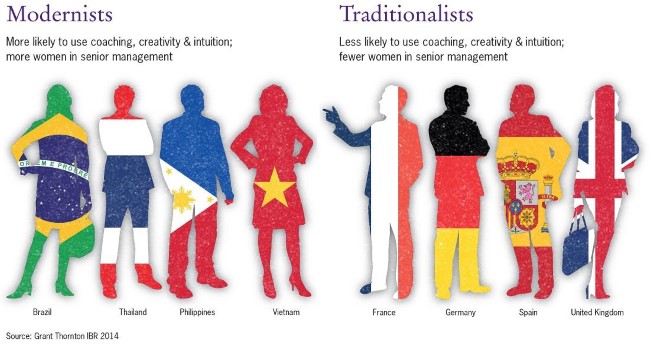
leadership profile modernists versus traditionalistsGrant Thornton revealed earlier this year that while leaders in these emerging economies display different behaviour, they are also more likely to be female. 32% of South East Asian senior business leaders are women, 29% in Asia Pacific and 28% in the BRICs. In comparison, only 21% of senior positions in the G7 are occupied by women, and 22% in the eurozone. At board level specifically, 26% of board members in BRIC economies are women, compared to just 16% in the G7 and 19% globally.

Francesca Lagerberg added: “There is a wealth of research suggesting that decision-making is affected by the gender balance on boards. As businesses with higher proportions of women in senior management tend to be found in emerging economies, the question is whether this offers them an advantage in the global race for growth.

"Economies in Europe and North America are picking up and business leaders are looking forward to the effect this will have on the growth of their own operations. But longer-term, the danger is that the diversity and openness to modern leadership styles exhibited by Modernist peers could result in better decision-making and, ultimately, stronger growth."

- ends - 

View a short video in which senior leaders from Grant Thornton discuss the results and offer insight into their own leadership styles.

Share this page
  • Facebook
  • Twitter
  • LinkedIn
  • WhatsApp
  • Xing
  • Email

Connect Connect

  • Meet our people
  • Contact us
  • Global reach

About About

  • About us
  • Careers
  • Press
  • Modern slavery statement
  • GPPC

Legal Legal

  • Privacy policy
  • Disclaimer
  • Site map
  • Unauthorised trademark use
  • Transparency report 2024
  • Cookie Preferences

Services Services

  • Advisory
  • Assurance
  • Tax

Follow usFollow us

© 2025 Grant Thornton International Ltd (GTIL) - All rights reserved. "Grant Thornton” refers to the brand under which the Grant Thornton member firms provide assurance, tax and advisory services to their clients and/or refers to one or more member firms, as the context requires. GTIL and the member firms are not a worldwide partnership. GTIL and each member firm is a separate legal entity. Services are delivered by the member firms. GTIL does not provide services to clients. GTIL and its member firms are not agents of, and do not obligate, one another and are not liable for one another’s acts or omissions.